
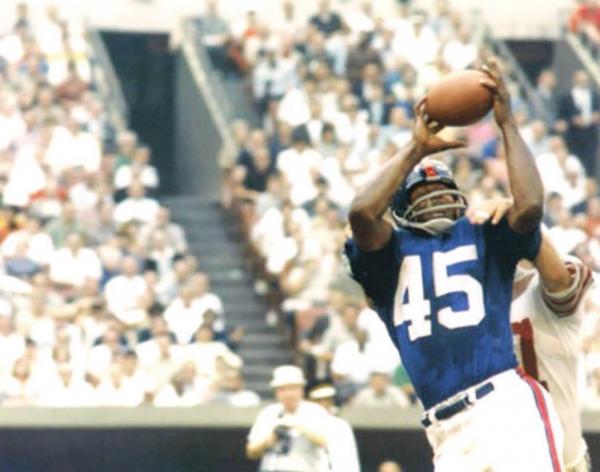
 Homer Jones COURTESY PHOTO
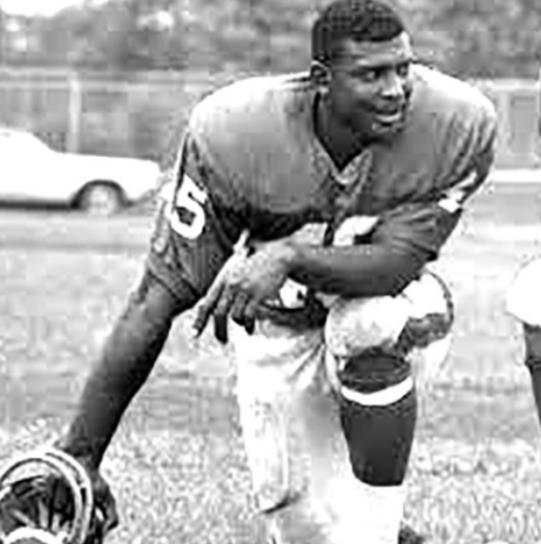 COURTESY PHOTO
June 24 marked 50th anniversary of Homer Jones’s NFL retirement
Pittsburg native and Texas Black Sports Hall of Fame inductee Homer Jones made quite the name for himself in the NFL, playing for the New York Giants and Cleveland Browns from 1964 to 1970. Jones scored 36 receiving touchdowns and averaged 22.3 yards per pass reception during his time in the NFL, but his legacy goes much further than that.
Jones was born in Pittsburg on February 18, 1941. He was an only child, born to a steelworker and a schoolteacher. He attended Frederick Douglass High School in Pittsburg. Growing up, Jones played the saxophone and dreamed of becoming a musician. However, in his senior year of high school, he tried out for the school’s football team and was an immediate success. Playing fullback, on his first play in high school, Jones rushed for 80 yards for a touchdown.
Jones received scholarship offers from nine universities. His college decision ultimately came down to Grambling State University, in Grambling, Louisiana, and Texas Southern University, in Houston, Texas. Preferring an urban campus to a rural campus and a campus that was closer to his home, Jones headed to Houston to attend Texas Southern.
Jones played football for Texas Southern from 1959 to 1962, beginning as a linebacker and then transitioning to halfback and flanker. While Jones was on its football team, Texas Southern posted records of 7-7 in 1959, 3-7 in 1960, 8-4 in 1961, and 7-3 in 1962. After playing at Texas Southern, Jones moved on to professional football.
In 1964, Jones began his rookie season with the New York Giants. In 1965, Jones played in all 14, and started three, regular season games. Jones scored his first NFL regular season touchdown on an 89-yard touchdown pass in a 35-27 New York victory over the Philadelphia Eagles on October 17, 1965.
Besides being Jones’ first NFL regular season touchdown and the longest pass reception in the 1965 regular season, the 89-yard touchdown reception by Jones has significance for how Jones acted after crossing the goal line. At this game, Jones pioneered touchdown celebrations.
Jones said during an interview with ESPN, “I was fixing to throw [the football] into the grandstand. But just as I was raising my arm, the reality snapped into my head. [NFL Commissioner Pete] Rozelle would have fined me [$50]. That was a lot of money in those days. So, I just threw the ball down into the end zone, into the grass. Folks got excited, and I did it for the rest of my career.”
In 1967, Jones received his first invitation to to the Pro Bowl. He also was named first-team All-Conference by the Sporting News, the Newspaper Enterprise Association, the New York Daily News, and United Press International, and second team All-Conference by the Associated Press.
Jones again started all 14 regular season games in 1968. For the second consecutive year, Jones received a Pro Bowl invitation. He also was named firstteam All-Conference by the Sporting News and second-team All-Conference by the New York Daily News.
In 1969, Jones, for the third consecutive year, started all 14 regular season games. For his play with New York from 1964 to 1969, Jones is considered one of the best receivers in Giants history.
On January 26, 1970, the Giants traded Jones to the
Cleveland Browns. In 1970, Jones played in all 14, and started four, regular season games for the Browns. In the regular season, Jones caught 10 passes for 141 yards. Jones ranked sixth in kickoff return yards and ninth in average yards per kickoff return (25.5 yards).
After six years of NFL success, Jones retired from the NFL on July 24, 1971
Jones still holds the NFL record of averaging 22.3 yards per reception throughout his career. He also holds the Giants franchise record for having 66.4 receiving yards per game over a career. His 4,845 receiving yards are the fifth-most, and his 35 receiving touchdowns are still tied for the fifth-most. The 218 receptions he had still rank 18th best in team history as well.

